
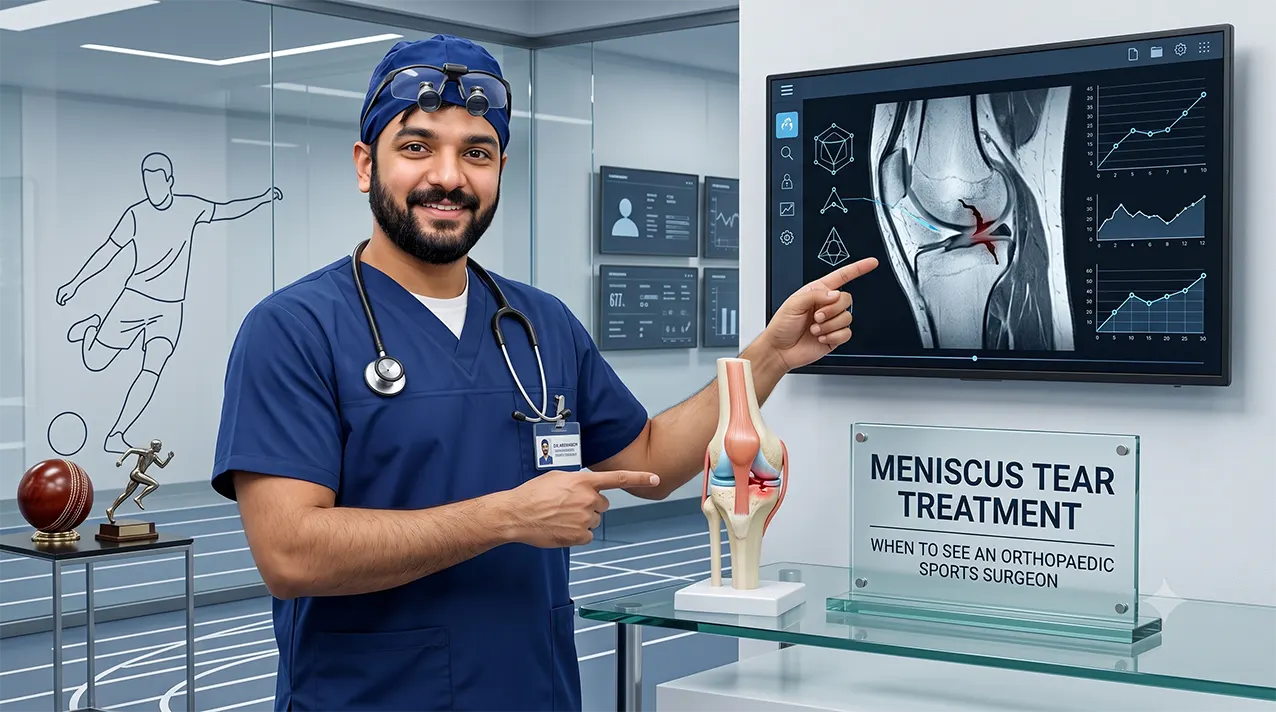
A meniscus tear is one of the most common causes of knee pain following a twisting or sports-related injury. It can affect athletes, active adults, and even older individuals with age-related changes in the meniscus.
Symptoms such as knee pain, swelling, clicking, catching, or locking should not be ignored, particularly when they persist after an injury.
If you have suffered a knee injury or have been diagnosed with a meniscal tear, an evaluation by an Orthopaedic Sports Surgeon in Kollam, such as Dr. Ashwin Roby, can help determine whether the injury can be treated without surgery or whether arthroscopic treatment may be appropriate.
What is a Meniscus?
The knee contains two menisci — the medial meniscus on the inner side and the lateral meniscus on the outer side.
These crescent-shaped structures sit between the thigh bone and shin bone and play an important role in:
-
Absorbing shock
-
Distributing forces across the knee
-
Improving knee stability
-
Protecting the joint cartilage
-
Facilitating smooth knee movement
Preserving the meniscus whenever possible is an important principle of modern knee surgery.
What Causes a Meniscus Tear?
Meniscal injuries commonly occur when the knee twists while the foot remains planted on the ground.
They can occur during athletic activities popular across Kerala, such as:
-
Football
-
Cricket
-
Badminton
-
Tennis
-
Basketball
-
Running
-
Gym and fitness activities
-
Sudden twisting movements
-
Squatting or lifting
Meniscal tears can also occur as part of the natural ageing process, particularly in people with degenerative changes in the knee.
In younger athletes, a meniscal tear may occur together with an ACL injury or other ligament injury.
Symptoms of a Meniscal Tear
A meniscus tear may cause:
-
Pain on the inner or outer side of the knee
-
Knee swelling
-
Clicking or popping
-
Catching sensation
-
Difficulty squatting
-
Pain while climbing stairs
-
Difficulty fully bending or straightening the knee
-
Knee locking
-
Difficulty running or changing direction
A knee that becomes locked and cannot be fully straightened should be assessed promptly.
How is a Meniscus Tear Diagnosed?
Diagnosis involves a combination of medical history, physical examination and appropriate imaging.
Clinical Examination: An Orthopaedic Sports Surgeon assesses the location of pain, knee movement, swelling, stability and specific signs that may suggest a meniscal injury.
X-Ray: An X-ray does not directly show the meniscus but can help evaluate the bones and identify other causes of knee pain.
MRI: An MRI of the knee can provide detailed information about the meniscus and other soft tissues, including:
-
ACL and PCL
-
Collateral ligaments
-
Articular cartilage
-
Bone marrow
-
Other structures around the knee
However, an MRI finding should always be interpreted along with the patient's symptoms and clinical examination.
Does Every Meniscus Tear Need Surgery?
No.
Not every meniscal tear requires an operation.
Depending on the type of tear and the patient's symptoms, treatment may include:
-
Rest and activity modification
-
Medication when appropriate
-
Physiotherapy
-
Muscle strengthening
-
Gradual return to activity
-
Arthroscopic surgery when indicated
The decision depends on factors such as the tear pattern, location, tissue quality, symptoms, age, activity level, associated injuries and response to conservative treatment.
Meniscus Repair: Preserving the Meniscus
When a meniscal tear has the potential to heal, meniscal repair may be considered.
During arthroscopic meniscal repair, the torn portions are brought together and secured using specialized sutures or repair devices.
The advantage of repair is that it aims to preserve the patient's own meniscus.
Meniscal preservation is particularly important in younger and active patients because loss of meniscal tissue can increase stress on the knee joint.
Partial Meniscectomy
Some meniscal tears cannot be repaired successfully because of their location, pattern, chronicity or tissue quality.
In selected cases, an arthroscopic partial meniscectomy may be performed. The unstable damaged portion is removed while preserving as much healthy meniscal tissue as possible.
The modern principle is “preserve the meniscus whenever possible” rather than routinely removing the torn meniscus.
Why See an Orthopaedic Sports Surgeon for a Meniscus Tear?
A meniscal tear should not always be considered as an isolated problem.
Sports-related knee injuries can involve multiple structures. For example, a patient with a meniscal tear may also have an ACL injury or cartilage damage.
An Orthopaedic Sports Surgeon at our Dr Damodaran Memorial hospital Kollam can assess the complete knee and determine an appropriate treatment strategy based on the patient's symptoms, activity requirements and associated injuries.
This may include deciding:
-
Whether surgery is necessary
-
Whether the meniscus can be repaired
-
Whether partial meniscectomy is appropriate
-
Whether there is an associated ACL or ligament injury
-
How the knee should be rehabilitated
-
When it is safe to return to sports
Knee Arthroscopy for Meniscal Injuries
Knee arthroscopy is a minimally invasive surgical technique used to diagnose and treat several knee conditions.
Small incisions are made around the knee through which a camera and specialized instruments are introduced.
Depending on the injury, arthroscopy may be used for:
-
Meniscal repair
-
Partial meniscectomy
-
ACL reconstruction
-
Treatment of selected cartilage injuries
-
Assessment and treatment of other intra-articular problems
The exact procedure depends on the individual patient's injury.
Rehabilitation After Meniscus Surgery
Surgery is only one part of successful treatment. Rehabilitation plays a major role in restoring knee function.
Depending on the procedure, rehabilitation may involve:
-
Reducing pain and swelling
-
Restoring knee range of motion
-
Improving quadriceps strength
-
Strengthening the hip and lower-limb muscles
-
Improving balance and proprioception
-
Gradually progressing to running
-
Sport-specific training
-
Return-to-sport assessment
Rehabilitation after a meniscal repair is generally more carefully progressed than after a simple partial meniscectomy because the repaired meniscus requires time to heal.
Returning to Sports After a Meniscus Tear
Many athletes can return to their previous level of activity following appropriate treatment and rehabilitation.
However, returning to sport should not be based solely on whether the pain has disappeared.
Before returning to demanding sports, factors such as:
-
Knee range of motion
-
Muscle strength
-
Balance
-
Functional performance
-
Movement control
-
Sport-specific ability
should be considered.
A gradual, structured return to sports can help reduce the risk of further injury.
When Should You Consult a Sports Surgeon in Kollam?
You should consider an evaluation if you experience:
-
Persistent knee pain after a twisting injury
-
Recurrent swelling
-
Knee locking
-
Clicking or catching
-
Difficulty fully straightening the knee
-
Pain while squatting or climbing stairs
-
Difficulty returning to sports
-
Persistent symptoms despite physiotherapy
-
An MRI showing a meniscal tear
Early assessment can help determine the most appropriate treatment and whether meniscal preservation is possible.
Meniscus Tear Treatment in Kollam
Treatment of a meniscal injury should be individualized. Some tears can be managed successfully without surgery, while selected symptomatic or unstable tears may benefit from arthroscopic treatment.
The goal of modern meniscal treatment is to preserve healthy meniscal tissue, treat associated injuries, restore knee function and facilitate a safe return to daily activities and sports.
If you have a meniscus tear, knee pain, swelling or locking following an injury, consultation with an Orthopaedic Sports Surgeon in Kollam can help you understand your treatment options. To schedule an expert evaluation, book an appointment with Dr. Ashwin Roby at Dr. K Damodaran Memorial Hospital today.
Frequently Asked Questions
-
Can a meniscus tear heal without surgery? Yes. Some meniscal tears, depending on their location, pattern and symptoms, can be managed with physiotherapy and other non-operative measures.
-
Is every meniscus tear seen on MRI clinically significant? Not necessarily. MRI findings need to be correlated with the patient's symptoms and clinical examination.
-
Is meniscus repair better than meniscus removal? When a tear is suitable for repair, preserving the meniscus is generally an important treatment objective. However, not every tear is repairable.
-
How long does it take to recover after meniscus surgery? Recovery varies considerably depending on the procedure. Rehabilitation after meniscal repair generally takes longer than after partial meniscectomy.
-
Can I play sports after a meniscus tear? Many patients can return to sports following appropriate treatment and rehabilitation. The timing should be individualized based on recovery and functional readiness.
-
Should I see an Orthopaedic Sports Surgeon for a meniscus tear? A Sports Surgeon can evaluate the meniscus along with the ACL, ligaments, cartilage and other structures of the knee and help determine the appropriate treatment strategy.