
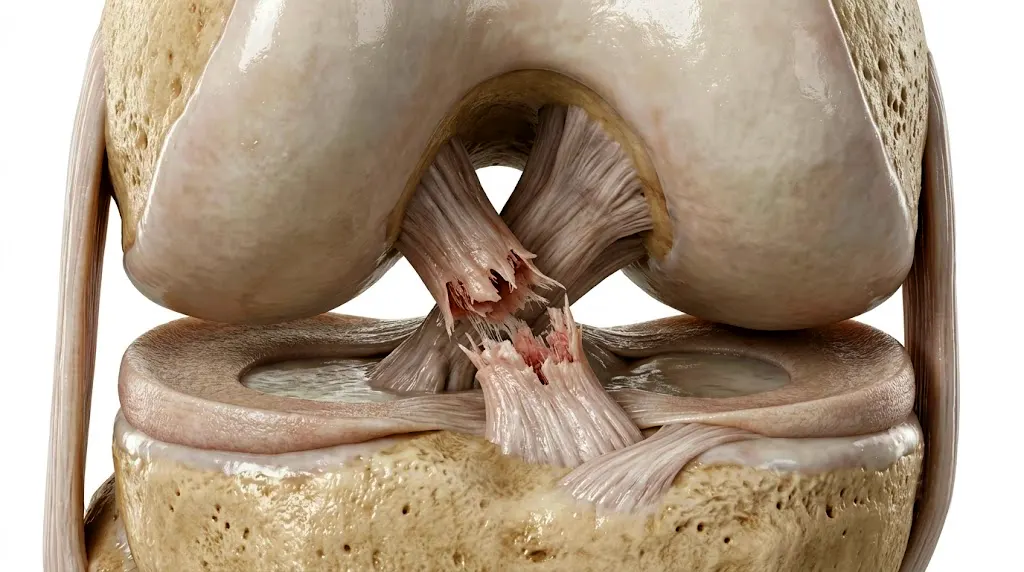
An anterior cruciate ligament (ACL) tear is one of the most common significant knee injuries we treat in Kollam, particularly among people who participate in sports involving running, jumping, pivoting and sudden changes in direction.
One of the most common questions after an ACL injury is:
“Do I need surgery, or can I manage this with physiotherapy?”
The answer is not the same for everyone.
An ACL tear on an MRI does not automatically mean that reconstruction is required. The decision depends on several factors, including knee stability, activity level, age, associated injuries, symptoms and the patient's goals.
What happens when the ACL is torn?
The ACL helps control forward movement and rotation of the tibia relative to the femur.
When the ligament is torn, some patients experience instability, particularly during activities involving pivoting or sudden changes in direction.
However, the degree of instability varies between individuals.
Some patients can return to everyday activities without significant problems, while others experience repeated episodes of the knee giving way.
When can an ACL tear be treated without surgery?
Non-operative treatment can be appropriate for selected patients.
Physiotherapy-based treatment may be considered when:
-
The knee is reasonably stable during daily activities
-
The patient does not participate in high-demand pivoting sports
-
There are no associated injuries requiring surgery
-
The patient is willing to modify activities
-
Symptoms improve with structured rehabilitation
-
The patient does not experience recurrent giving-way episodes
A rehabilitation programme usually focuses on restoring knee movement, strengthening the quadriceps and hamstrings, improving balance and coordination, and progressively improving functional ability.
When is ACL reconstruction more likely to be recommended?
Surgery may be considered when the patient has significant functional instability or wants to return to activities that place high demands on the ACL.
Important factors include:
-
Repeated episodes of giving way If the knee repeatedly buckles or gives way, particularly during normal activities or sports, reconstruction may be considered. Repeated instability can expose the meniscus and articular cartilage to additional injury.
-
Desire to return to pivoting sports Football, basketball, badminton, tennis and similar sports popular across Kerala require repeated pivoting, cutting and rapid changes in direction. For an athlete wishing to return to these activities, a persistently unstable ACL-deficient knee may be problematic.
-
Physically demanding occupation People whose occupations involve climbing, running, frequent pivoting or other physically demanding activities may require a greater degree of knee stability.
-
Associated meniscal or other injuries ACL tears may occur together with meniscal tears, cartilage injuries or other ligament injuries. The presence and nature of these injuries can influence whether surgery is recommended.
-
Persistent instability despite rehabilitation A structured rehabilitation programme can significantly improve strength and function. However, if the knee continues to give way despite appropriate rehabilitation, reconstruction may become a reasonable option.
Does age determine whether I need ACL surgery?
Age alone should not determine treatment.
A younger athlete who wants to return to competitive pivoting sports may have very different requirements from an older individual whose main goal is comfortable walking, cycling or performing daily activities.
Therefore, the decision should be based on functional requirements and knee stability rather than age alone.
What is the role of physiotherapy?
Physiotherapy is important whether or not surgery is ultimately performed.
If surgery is not planned: Rehabilitation aims to help the patient function safely with the ACL-deficient knee. It may include:
-
Quadriceps strengthening
-
Hamstring strengthening
-
Hip and core strengthening
-
Balance and proprioception training
-
Neuromuscular control
-
Sport-specific movement training
-
Activity modification
If surgery is planned: Physiotherapy before surgery—often called prehabilitation—can help reduce swelling, restore full knee extension, improve flexion and strengthen the muscles. Good preoperative function can make postoperative rehabilitation easier.
Does physiotherapy make the ACL grow back?
This is an important distinction.
Physiotherapy can improve muscle strength, coordination and functional stability, but it does not reliably recreate the normal anatomical ACL in a completely torn ligament.
Some patients can nevertheless function well despite an ACL tear because the surrounding muscles and neuromuscular system compensate sufficiently for their activities.
Therefore, the goal of non-operative treatment is not necessarily to “heal the ACL,” but to restore safe and satisfactory knee function.
What if I want to play sports again?
This is one of the most important considerations.
If your goal is to return to a sport involving repeated pivoting and cutting, the demands placed on the knee are substantially greater than those involved in routine daily activities.
Some individuals can return to sports without reconstruction, but recurrent instability is an important concern.
For athletes considering return to high-demand sports, the decision should involve assessment of:
-
Knee stability
-
Muscle strength
-
Movement control
-
Sport-specific demands
-
Associated injuries
-
Previous episodes of giving way
-
Rehabilitation progress
Is surgery always better than physiotherapy?
There is no single treatment that is best for every patient.
ACL reconstruction can restore mechanical stability, but it is still surgery and requires a substantial rehabilitation period.
Non-operative treatment avoids surgery but may not provide sufficient stability for everyone, particularly individuals with recurrent instability or high-demand sporting requirements.
The appropriate choice therefore depends on the individual rather than simply on the MRI diagnosis.
What happens if I leave an ACL tear untreated?
“Untreated” does not necessarily mean “doing nothing.”
A patient who chooses non-operative treatment should generally undergo appropriate rehabilitation and monitoring.
If the knee remains unstable, repeated giving-way episodes may occur. These episodes can be associated with additional meniscal or cartilage injury.
However, not every patient with an ACL tear will develop these problems. This is why the decision should be individualized.
Can I delay ACL reconstruction?
In many situations, ACL reconstruction does not need to be performed immediately after the injury.
It is often beneficial to first reduce swelling and restore knee movement and muscle function.
However, prolonged instability should not simply be ignored, particularly in an active patient experiencing recurrent giving-way episodes.
The appropriate timing of surgery depends on the individual patient's condition and goals.
A simple way to think about the decision
Rather than asking only: “Is my ACL torn?”
it is more useful to ask: “Is my knee stable enough for the activities I want to do?”
The decision can be broadly considered around four questions:
Is the knee stable? If yes, rehabilitation may be sufficient for some patients.
Does the knee repeatedly give way? If yes, reconstruction may need to be considered.
Do you want to return to pivoting sports or demanding physical activity? If yes, the stability requirements are higher.
Are there associated meniscal, cartilage or ligament injuries? If yes, these may influence the treatment plan.
ACL surgery and rehabilitation go together
Patients sometimes think of ACL reconstruction as the treatment and physiotherapy as something that happens afterward.
In reality, rehabilitation is an integral part of ACL treatment.
A successful recovery requires progressive:
-
Range-of-motion exercises
-
Strengthening
-
Balance and neuromuscular training
-
Running progression
-
Jumping and landing training
-
Sport-specific exercises
-
Return-to-sport assessment
Returning to sport should be based on recovery milestones rather than simply waiting for a particular number of months.
When should you see an orthopaedic knee specialist in Kollam?
An evaluation is particularly important if you have:
-
A confirmed ACL tear
-
Recurrent knee instability
-
Repeated swelling after activity
-
Difficulty returning to sports
-
Associated meniscal or cartilage injury
-
Persistent symptoms despite physiotherapy
A clinical examination combined with appropriate imaging can help determine whether continued rehabilitation or ACL reconstruction is more appropriate.
Conclusion
An ACL tear does not automatically mean that you need surgery.
For some patients, structured physiotherapy and appropriate activity modification can provide satisfactory knee function. For others—particularly those with recurrent instability, associated injuries or a desire to return to high-demand pivoting sports—ACL reconstruction may be appropriate.
The decision should be based on the patient's knee stability, lifestyle, sporting goals, associated injuries and response to rehabilitation, rather than on the MRI report alone.
The right treatment is the one that provides the appropriate level of stability and function for the patient's individual goals. If you are dealing with a knee injury, scheduling a consultation with Dr. Ashwin Roby at Dr. K Damodaran Memorial Hospital in Kollam can help you determine the safest and most effective path forward for your recovery.