
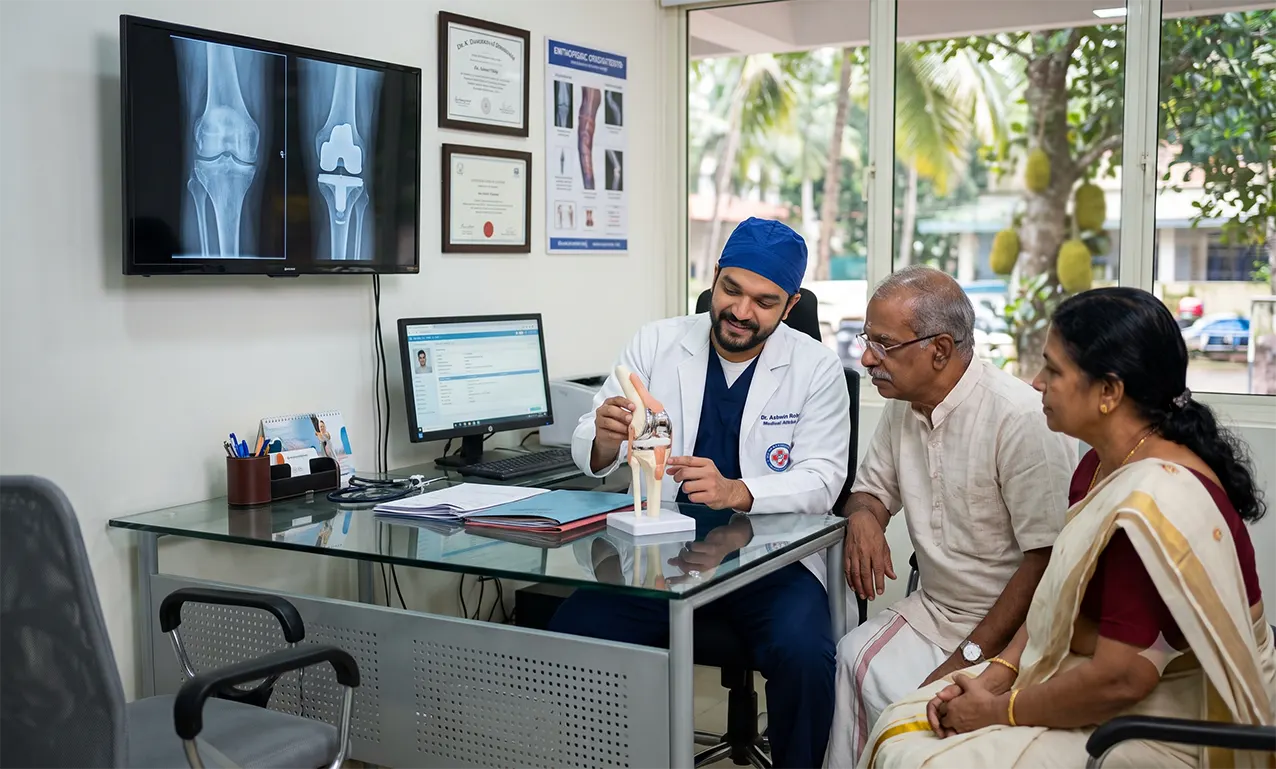
WHEN SHOULD YOU CONSIDER TOTAL KNEE REPLACEMENT SURGERY?
Knee pain can gradually affect almost every aspect of daily life — from walking and climbing stairs to sitting comfortably, getting up from a chair, or sleeping at night. One of the most common causes of persistent knee pain in adults, particularly older individuals, is knee osteoarthritis, a condition in which the protective cartilage inside the knee joint gradually wears away.
When knee arthritis becomes advanced and pain continues despite appropriate treatment, Total Knee Replacement (TKR), also known as Total Knee Arthroplasty (TKA), can offer significant relief from pain and improve mobility and quality of life.
At the Advanced Orthopaedic Centre, Dr K Damodaran Memorial Hospital, Chinnakada, Kollam—recognised among the best orthopaedic hospitals in Kollam—Dr Ashwin Roby provides evaluation and treatment for patients with knee arthritis, including assessment for knee replacement surgery. ( joint replacement in Kollam)
But how do you know when it is the right time to undergo a knee replacement? Understanding the symptoms, available treatment options, and factors that influence the decision can help you make an informed choice.
WHAT IS TOTAL KNEE REPLACEMENT SURGERY?
Total Knee Replacement is a surgical procedure in which the damaged joint surfaces of the knee are replaced with artificial components called prostheses.
The damaged cartilage and a small amount of underlying bone are removed from the ends of the thigh bone (femur) and shin bone (tibia). These surfaces are replaced with specially designed metal components, with a medical-grade plastic bearing placed between them to allow smooth movement. The undersurface of the kneecap may also be resurfaced when indicated.
The main goals of Total Knee Replacement Surgery are to:
-
Relieve pain caused by advanced arthritis.
-
Improve walking ability and everyday mobility.
-
Correct significant deformity, such as bow legs or knock knees, when appropriate.
-
Improve the ability to perform routine activities.
-
Enhance overall quality of life.
A knee replacement does not restore the original natural joint, but it can substantially reduce pain and improve function in appropriately selected patients.
WHEN SHOULD YOU GO FOR TOTAL KNEE REPLACEMENT SURGERY?
The right time for knee replacement is determined by the severity of your symptoms, the extent of joint damage, and how much your knee pain affects your daily life — not by your age or X-ray findings alone.
You may need to consider Total Knee Replacement Surgery if you experience the following problems.
-
PERSISTENT KNEE PAIN THAT AFFECTS DAILY ACTIVITIES Knee pain that continues for several months and interferes with routine activities may indicate advanced arthritis. The pain may initially occur only during walking or prolonged standing, but as the condition progresses, it may occur even with minimal activity.
If knee pain prevents you from enjoying your normal daily activities despite appropriate treatment, it is worth consulting a trusted orthopaedic doctor in Kollam to discuss your options.
-
DIFFICULTY WALKING OR CLIMBING STAIRS Patients with advanced knee arthritis may experience difficulty walking even short distances, climbing stairs, standing for extended periods, or getting up from a chair.
When knee pain significantly restricts mobility and independence, knee replacement may help restore functional ability.
-
KNEE PAIN AT REST OR AT NIGHT Pain that occurs while resting or disturbs sleep may indicate more advanced joint disease, although other causes must also be considered.
If knee pain repeatedly interrupts your sleep or makes it difficult to find a comfortable position, an orthopaedic evaluation is recommended.
-
BOW LEGS OR KNOCK KNEES Advanced arthritis can cause progressive deformity of the knee, resulting in bow legs (varus deformity) or knock knees (valgus deformity).
When deformity becomes significant and is associated with pain and functional limitation, Total Knee Replacement may be recommended. Earlier assessment is useful because severe deformity can make surgery more complex.
-
NON-SURGICAL TREATMENTS ARE NO LONGER EFFECTIVE Knee replacement is generally considered when appropriate conservative treatments fail to provide adequate relief.
These treatments may include:
-
Physiotherapy and strengthening exercises.
-
Weight management, when appropriate.
-
Pain-relieving medications prescribed according to individual needs.
-
Walking aids or activity modification.
-
Selected injections in appropriate patients.
You do not necessarily need to try every available treatment before considering surgery. The decision depends on your symptoms, the severity of arthritis, your medical condition, and your treatment goals.
HOW DO YOU KNOW IF YOU ARE READY FOR KNEE REPLACEMENT?
The following checklist can help you recognise when it is time to seek an orthopaedic assessment.
-
Knee pain affects walking or standing.
-
Difficulty climbing stairs or getting up from a chair.
-
Pain disturbs sleep or occurs at rest.
-
Knee deformity is increasing.
-
Pain persists despite appropriate treatment.
-
Daily activities and quality of life are significantly affected.
If several of these problems apply to you, consider consulting an orthopaedic surgeon. This checklist is for guidance and does not replace an examination.
IS THERE AN IDEAL AGE FOR TOTAL KNEE REPLACEMENT?
There is no single ideal age for Total Knee Replacement Surgery. The decision is based primarily on symptoms, joint damage, functional limitations, overall health, and the expected benefits of surgery.
Below 50 years: Knee replacement may be appropriate in selected patients with severe arthritis, but the possibility of revision surgery later in life needs careful consideration. Between 50 and 65 years: Surgery may be appropriate when arthritis causes substantial pain and disability despite suitable treatment. Above 65 years: Many patients benefit from knee replacement, provided their overall health and functional needs support surgery.
Age alone should not be a reason to deny an otherwise appropriate patient surgery. Similarly, having severe arthritis on an X-ray does not automatically mean that surgery is necessary if symptoms remain manageable.
WHAT ARE THE STAGES OF KNEE ARTHRITIS?
EARLY ARTHRITIS Mild pain during activity, occasional stiffness, and limited X-ray changes. Treatment usually focuses on exercise, physiotherapy, activity modification, and weight management where appropriate.
MODERATE ARTHRITIS More frequent pain, stiffness, and difficulty with stairs or prolonged walking. A combination of non-surgical treatments may help, depending on the severity and functional impact.
SEVERE ARTHRITIS Marked cartilage loss, persistent pain, restricted mobility, or deformity. If symptoms remain disabling despite appropriate treatment, knee replacement may be the most effective option.
Weight-bearing X-rays of the knee, sometimes including a standing full-length alignment view, help assess the severity and distribution of arthritis. MRI is not routinely required to diagnose typical advanced knee osteoarthritis when clinical assessment and X-rays provide sufficient information.
WHAT HAPPENS DURING TOTAL KNEE REPLACEMENT SURGERY?
Total Knee Replacement is performed under spinal or general anaesthesia, depending on the patient's health and the anaesthesia team's assessment.
The procedure generally involves the following steps:
-
Preoperative assessment: Medical fitness, blood investigations, imaging, and anaesthesia assessment are completed.
-
Surgical exposure: The surgeon accesses the knee joint through an incision.
-
Preparation of bone surfaces: Damaged cartilage and small amounts of underlying bone are removed from the femur and tibia.
-
Implant placement: Artificial components are positioned to restore appropriate alignment, stability, and joint movement.
-
Balancing and closure: The surgeon checks ligament balance, stability, and range of motion before closing the wound.
-
Postoperative rehabilitation: Pain management and supervised mobilisation begin according to the patient's recovery and clinical condition.
The choice of implant and surgical technique depends on the patient's anatomy, bone quality, ligament condition, degree of deformity, and the surgeon's assessment.
HOW LONG DOES IT TAKE TO RECOVER AFTER KNEE REPLACEMENT?
Recovery occurs gradually, and progress varies between patients.
FIRST 1–3 DAYS Many patients begin standing and walking with assistance on the day of surgery or the following day, if medically appropriate.
FIRST 2–6 WEEKS Walking distance, knee movement, strength, and independence generally improve with regular rehabilitation. Walking aids may still be required.
6–12 WEEKS AND BEYOND Many patients achieve substantial functional improvement, but swelling, stiffness, and strength recovery can continue for several months.
Physiotherapy, home exercises, wound care, and adherence to postoperative instructions are important for a successful recovery. Return to driving, work, and other activities should be individualised.
HOW LONG DOES A KNEE REPLACEMENT LAST?
Modern knee replacement implants can last many years. Many studies report that approximately 90–95% of knee replacements remain in place at 10 years, and around 80–85% at 20 years, although outcomes vary by implant, patient characteristics, activity, and surgical factors.
Implant longevity can be influenced by:
-
Body weight and activity levels.
-
Implant positioning and fixation.
-
Bone quality and general health.
-
Infection or other postoperative complications.
-
Wear and loosening over time.
Younger patients may need revision surgery during their lifetime, so this possibility should be discussed before proceeding.
WHAT ARE THE RISKS OF TOTAL KNEE REPLACEMENT?
Total Knee Replacement is an established procedure, but like any major surgery, it has potential risks.
These include:
-
Infection.
-
Blood clots in the legs or lungs.
-
Bleeding or wound-healing problems.
-
Persistent pain or stiffness.
-
Nerve or blood vessel injury, rarely.
-
Implant loosening, wear, or the need for revision surgery.
Preoperative optimisation, appropriate infection prevention, blood clot prevention, and a structured rehabilitation programme help reduce risk. Your surgeon will explain how your individual medical conditions may affect the procedure.
CAN KNEE REPLACEMENT BE AVOIDED?
Knee replacement is not necessary for every person with knee arthritis. Many patients can manage symptoms for years without surgery.
Depending on the condition, treatment may include:
-
Strengthening exercises and physiotherapy.
-
Weight management, if required.
-
Activity modification and appropriate walking aids.
-
Suitable pain-relieving medication.
-
Selected injections in appropriate cases.
-
Other joint-preserving treatments for carefully selected patients.
However, when arthritis is advanced and pain continues to restrict daily life despite appropriate treatment, repeatedly postponing a suitable operation may prolong unnecessary suffering and loss of mobility.
The goal is neither to recommend surgery too early nor to delay it unnecessarily. It is to identify the point at which the expected benefits of surgery outweigh its risks for the individual patient.
WHY CONSULT DR ASHWIN ROBY FOR KNEE REPLACEMENT IN KOLLAM?
Dr Ashwin Roby is widely considered a leading knee replacement surgeon in Kollam with expertise in joint replacement, arthroscopy, sports medicine, and trauma surgery.
At the Advanced Orthopaedic Centre, Dr K Damodaran Memorial Hospital, Chinnakada, Kollam, patients can seek assessment for knee osteoarthritis and discuss appropriate treatment options, including Total Knee Replacement Surgery.
The treatment plan is based on clinical examination, X-ray findings, functional limitations, medical fitness, and the patient's expectations.
If persistent knee pain is limiting your mobility, an orthopaedic consultation can help you understand whether continued non-surgical treatment or knee replacement is the better option for you.
FREQUENTLY ASKED QUESTIONS (FAQs)
-
WHEN SHOULD I UNDERGO TOTAL KNEE REPLACEMENT SURGERY?
You should consider surgery when knee arthritis causes persistent pain, difficulty walking, sleep disturbance, deformity, or substantial limitations in daily activities despite appropriate non-surgical treatment. The final decision should follow an orthopaedic assessment. -
IS KNEE REPLACEMENT NECESSARY IF MY X-RAY SHOWS SEVERE ARTHRITIS?
Not always. X-ray findings must be considered alongside your symptoms, mobility, examination, and quality of life. Surgery is generally most beneficial when significant symptoms correspond to the joint damage. -
CAN I DELAY KNEE REPLACEMENT SURGERY?
In many cases, surgery can be delayed if symptoms remain manageable and there are no other concerning problems. However, if pain, deformity, or disability is progressively worsening, discuss the consequences of further delay with your surgeon. -
IS TOTAL KNEE REPLACEMENT A MAJOR SURGERY?
Yes. It is a major orthopaedic procedure that requires preoperative medical assessment, anaesthesia, postoperative care, and rehabilitation. Most patients can begin mobilisation early, subject to their clinical condition. -
WILL I BE ABLE TO WALK NORMALLY AFTER KNEE REPLACEMENT?
Many patients experience substantial improvement in walking and everyday activities. The final outcome depends on preoperative mobility, muscle strength, deformity, general health, and rehabilitation. A completely normal-feeling knee cannot be guaranteed. -
HOW MANY DAYS WILL I NEED TO STAY IN HOSPITAL?
Hospital stay varies according to medical fitness, recovery, mobility, and local protocols. Some patients are discharged within a few days, while others require a longer stay. -
CAN BOTH KNEES BE REPLACED AT THE SAME TIME?
Simultaneous bilateral knee replacement may be suitable for selected patients. The decision depends on overall health, anaesthetic risk, functional status, and the expected benefits and risks compared with staged surgery. -
IS KNEE REPLACEMENT POSSIBLE FOR PATIENTS WITH DIABETES OR HIGH BLOOD PRESSURE?
Yes, many patients with these conditions can undergo surgery when their medical problems are appropriately assessed and controlled. Optimising blood glucose, blood pressure, and other medical conditions helps reduce complications. -
HOW MUCH DOES TOTAL KNEE REPLACEMENT SURGERY COST IN KOLLAM?
Total knee replacement cost in Kollam depends on the implant selected, hospital facilities, length of stay, investigations, medicines, and rehabilitation requirements. Contact the hospital for a patient-specific estimate. -
WHOM SHOULD I CONSULT FOR KNEE REPLACEMENT IN KOLLAM?
You can consult Dr Ashwin Roby at the Advanced Orthopaedic Centre, Dr K Damodaran Memorial Hospital, Hospital Road, Chinnakada, Kollam, for expert assessment of knee arthritis and advice regarding appropriate treatment from a top joint replacement specialist.