
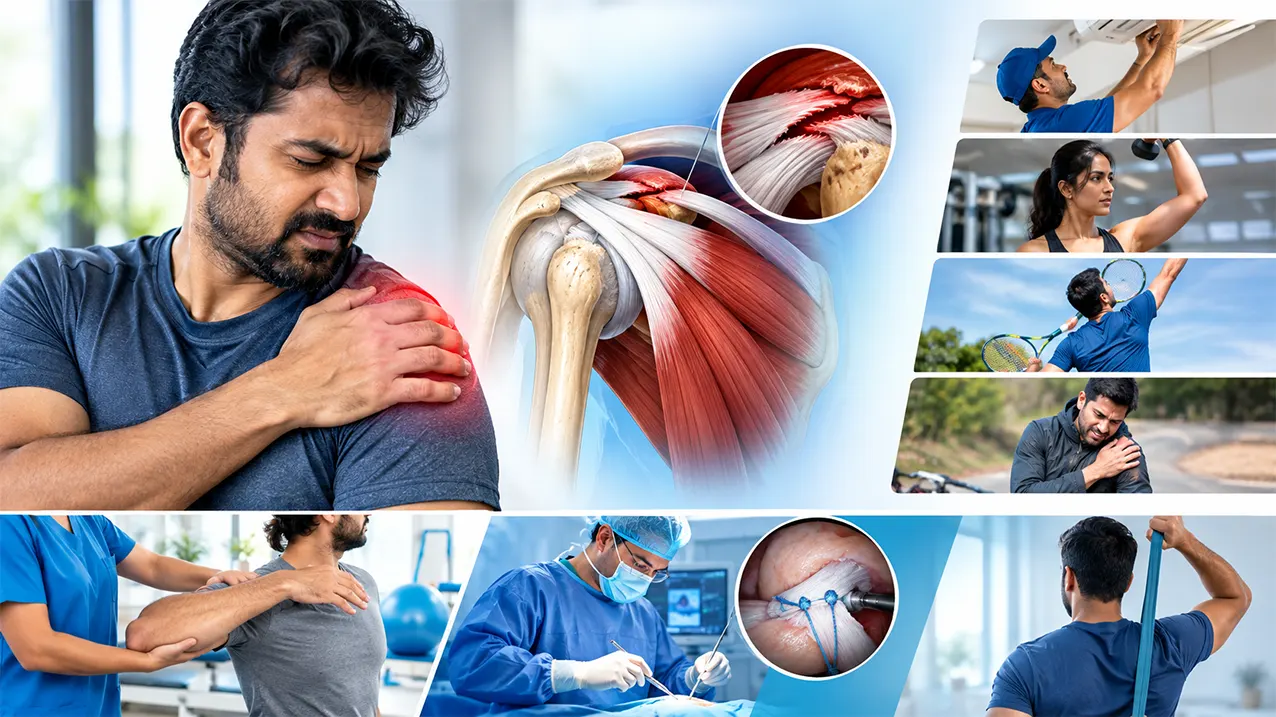
Rotator cuff problems are one of the most common causes of shoulder pain for patients we treat here in Kollam, particularly in adults who are active, perform repetitive overhead activities, or have sustained a shoulder injury. While many rotator cuff problems improve with appropriate non-surgical treatment, some patients with significant or persistent tears may benefit from surgery.
Modern rotator cuff surgery is commonly performed using shoulder arthroscopy, a minimally invasive technique that allows the surgeon to assess and treat the shoulder through small incisions.
What is the rotator cuff?
The rotator cuff is a group of four muscles and their tendons that surround the shoulder joint. These tendons help stabilize the shoulder and allow movements such as lifting, rotating and reaching overhead.
A rotator cuff tendon can become damaged because of:
- Acute injuries, such as a fall or sudden lifting injury
- Repetitive overhead activity
- Age-related tendon degeneration
- Long-standing impingement or tendon disease
- Previous shoulder problems
A tear may be partial or complete and can vary considerably in size and severity.
What are the symptoms of a rotator cuff tear?
Common symptoms include:
- Pain while lifting the arm
- Pain when reaching overhead
- Night pain, particularly when lying on the affected side
- Weakness of the shoulder
- Difficulty performing activities such as dressing or reaching behind the back
- Loss of shoulder function
- Pain following a sudden injury
Not every rotator cuff tear causes symptoms. Some tears are discovered incidentally on an MRI scan in people who have little or no shoulder pain.
How is a rotator cuff tear diagnosed?
Diagnosis begins with a detailed clinical examination. Your orthopaedic surgeon will assess shoulder movement, strength and specific tests that help identify rotator cuff pathology.
Depending on the clinical findings, investigations may include:
X-rays:
These help assess the bones, joint space and other conditions such as arthritis or changes around the shoulder.
Ultrasound:
This can be useful for evaluating the rotator cuff tendons dynamically.
MRI:
MRI provides detailed information about the rotator cuff, including the location and size of a tear, tendon retraction, muscle quality and associated shoulder problems.
The treatment decision should be based on the patient's symptoms and clinical findings rather than an MRI report alone.
Does every rotator cuff tear require surgery?
No.
Many patients with rotator cuff tears can be managed successfully without surgery. Treatment may include:
- Activity modification
- Physiotherapy
- Strengthening and mobility exercises
- Pain-relieving medication when appropriate
- Treatment of associated shoulder conditions
The decision to consider surgery depends on several factors, including the patient's age, activity level, symptoms, tear characteristics, weakness, duration of symptoms and response to non-operative treatment.
Surgery may be considered particularly when there is:
- A traumatic full-thickness tear with significant weakness
- Persistent pain despite appropriate non-surgical treatment
- Significant functional limitation
- A tear in an active patient where restoration of shoulder strength and function is important
- Progressive symptoms or a tear with features suggesting that repair may be beneficial
What is rotator cuff repair surgery?
The goal of rotator cuff repair is to reattach the torn tendon to its normal attachment on the upper end of the arm bone (humerus).
Most repairs can be performed using arthroscopic surgery.
During the procedure, a small camera is introduced into the shoulder joint through a small incision. Additional small portals allow specialized instruments to be introduced.
The surgeon can:
- Examine the shoulder joint and rotator cuff.
- Identify the location and extent of the tear.
- Treat associated problems when necessary.
- Prepare the tendon attachment site on the humerus.
- Reattach the torn tendon using specialized suture anchors and sutures.
The exact procedure varies depending on the type and extent of the tear.
Are other procedures performed along with rotator cuff repair?
Sometimes.
Depending on the individual patient's pathology, additional procedures may be performed during the same operation. These may include treatment of:
- Biceps tendon pathology
- Labral tears
- Subacromial bursitis
- Acromial abnormalities
- Shoulder joint cartilage problems
These procedures are not required in every patient. The treatment plan is individualized according to the findings.
What happens after rotator cuff surgery?
Recovery after rotator cuff repair is gradual because the tendon needs time to heal back to bone.
Typically, the arm is protected in a sling for a period determined by the surgeon. Physiotherapy is then progressed in stages.
Early phase
The initial focus is on protecting the repair and maintaining appropriate shoulder mobility, often with guided passive or assisted exercises.
Intermediate phase
As healing progresses, active shoulder movement is gradually introduced, followed by strengthening exercises.
Strengthening phase
Progressive strengthening of the rotator cuff and shoulder-blade muscles is introduced when the repair has sufficiently healed.
Return to activity
Return to work, sports and overhead activities depends on the type of repair, tendon healing, muscle strength and the individual's functional requirements.
Recovery is therefore measured in months rather than weeks.
What are the risks of rotator cuff surgery?
Rotator cuff repair is generally a commonly performed procedure, but like any surgery it has potential risks.
These may include:
- Infection
- Stiffness
- Persistent pain
- Failure or incomplete healing of the tendon
- Re-tear
- Nerve or blood-vessel injury, which is uncommon
- Anaesthetic-related complications
The risk of re-tear can depend on factors such as tear size, tendon quality, muscle condition, age, smoking and the rehabilitation process.
Can a rotator cuff tear heal without surgery?
Some smaller or partial-thickness tears may be managed successfully without surgery, particularly when symptoms improve with appropriate rehabilitation.
However, a torn tendon that has completely detached from its normal attachment does not necessarily restore its original anatomy simply through exercise. The decision to operate therefore depends on the patient's symptoms, functional requirements and the characteristics of the tear.
When should you see an orthopaedic shoulder specialist?
You should consider an evaluation if you have persistent shoulder pain, weakness, difficulty lifting the arm, significant night pain, or symptoms following a shoulder injury.
Early assessment can help determine whether the problem is related to the rotator cuff or another shoulder condition and whether treatment should be surgical or non-surgical.
The goal of rotator cuff treatment
The objective of treatment is not simply to repair an MRI abnormality. The aim is to reduce pain, restore shoulder function and help the patient return to the activities that matter to them.
For patients who require surgery, modern arthroscopic techniques combined with structured rehabilitation can provide an effective approach to treating appropriate rotator cuff tears.
Frequently Asked Questions
Is rotator cuff surgery always done through keyhole surgery?
Many rotator cuff repairs can be performed arthroscopically through small incisions. The surgical technique depends on the tear and the individual patient.
How long does rotator cuff surgery take?
The duration varies depending on the complexity of the tear and whether additional procedures are required.
How long will I need a sling?
This varies according to the size and type of repair and your surgeon's rehabilitation protocol.
When can I drive after surgery?
Driving should only be resumed when you can safely control the vehicle and are no longer restricted by the sling, pain or medication. Your surgeon can advise you based on your individual recovery.
When can I return to sports?
Return to sports is gradual and depends on tendon healing, strength and the demands of the particular sport.
Will my shoulder become completely normal after surgery?
Many patients experience substantial improvement in pain and function, but the outcome depends on factors such as the size and chronicity of the tear, tendon quality, muscle condition, associated pathology and rehabilitation.
Conclusion
Rotator cuff tears are common, but the appropriate treatment is different for every patient. Some tears can be managed effectively without surgery, while others may benefit from arthroscopic repair.
A detailed clinical assessment, appropriate imaging and discussion of the patient's goals are essential before deciding on surgery.
If you have persistent shoulder pain or weakness, scheduling an orthopaedic shoulder evaluation with Dr. Ashwin Roby at Dr. K Damodaran Memorial Hospital in Kollam can help determine the cause and the most appropriate treatment for your condition.