
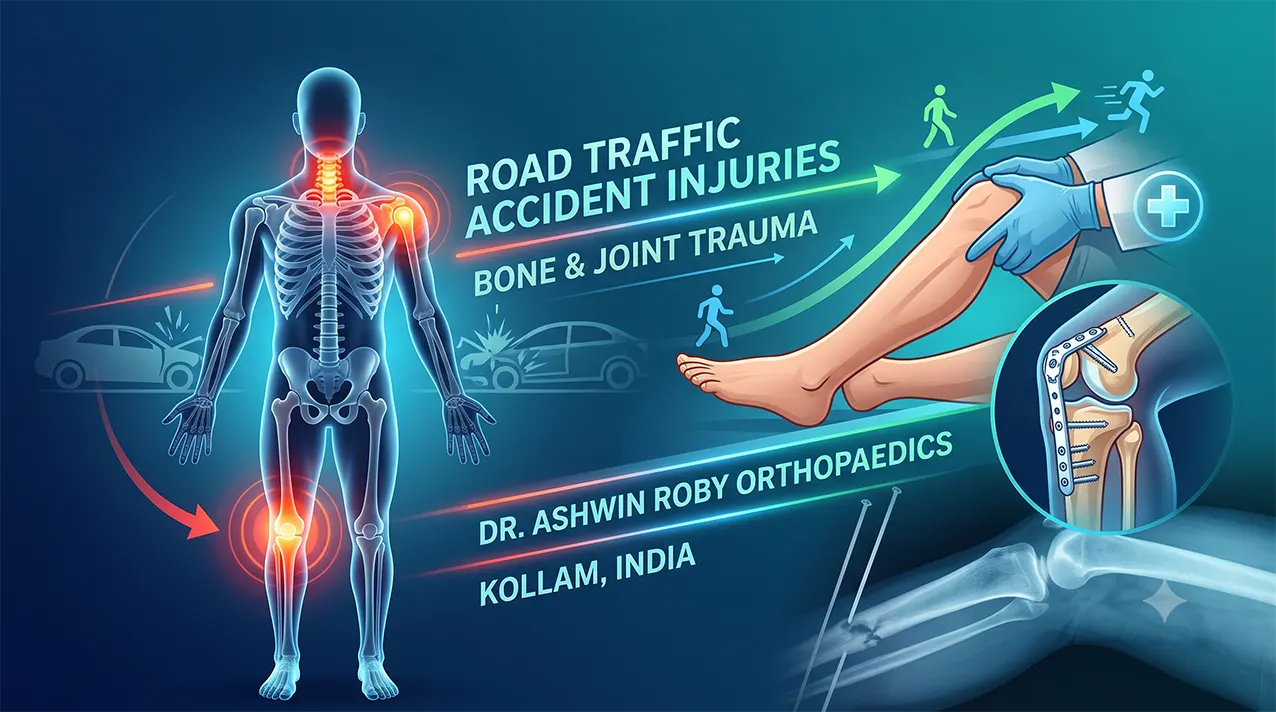
When a road traffic accident occurs, the immediate focus is understandably on life-threatening trauma and visible bleeding. However, as an orthopaedic surgeon, I frequently treat patients who arrive weeks after a collision struggling with chronic pain, severe stiffness, and restricted mobility. They often assumed their joint pain or muscle ache was just a temporary side effect of the crash.
High-velocity impacts place immense, unnatural torque on your musculoskeletal system. Bones, joints, ligaments, and tendons absorb this kinetic energy, often resulting in complex orthopedic injuries that require immediate, specialized care.
The Hidden Danger of Adrenaline
In the immediate aftermath of a crash, your body is flooded with adrenaline and endorphins. This natural "fight or flight" response acts as a powerful biological painkiller. You might walk away from a collision feeling perfectly fine, only to wake up the next morning unable to turn your neck or bear weight on your leg.
Never assume you are uninjured simply because you feel no immediate pain. Ignoring the warning signs of internal tissue damage can turn a highly treatable sprain into a chronic condition requiring invasive orthopedic surgery or long-term pain management.
The Most Common Orthopaedic Trauma from Collisions
The mechanism of injury in a vehicle collision dictates the type of trauma sustained. The most frequent conditions we see at the bone and joint center include:
-
"Dashboard Knee" and Joint Trauma: The knee is highly vulnerable during a frontal collision. When the knee strikes the dashboard, the impact can drive the thigh bone backward, leading to a posterior cruciate ligament (PCL) tear, a shattered kneecap (patellar fracture), or severe cartilage damage. If left untreated, these injuries accelerate joint degeneration, sometimes necessitating a partial or total knee replacement years earlier than expected.
-
Complex Bone Fractures: Unlike a simple fall, the blunt force of a car accident often causes comminuted fractures, where the bone shatters into several pieces. We frequently treat severe fractures of the femur, tibia, wrists, and collarbones.
-
Spinal Compression and Whiplash: Sudden deceleration throws the neck and spine forward and backward in a whip-like motion. This violent movement tears neck ligaments and can cause herniated discs or vertebral compression fractures, leading to referred pain and tingling down the arms or legs.
-
Shoulder Dislocation and Rotator Cuff Tears: Bracing for impact against the steering wheel or the sudden locking of a seatbelt can forcefully dislocate the shoulder joint or tear the surrounding stabilizing tendons.
Clinical insight: In severe trauma cases, a bone specialist will utilize internal fixation—using surgical pins, plates, or screws—to realign and stabilize the shattered bone fragments so they heal in the exact anatomical position.
A Doctor’s Advice: Your First 48 Hours
The actions you take in the first 48 hours post-accident dictate your long-term recovery trajectory.
-
Seek an Immediate Clinical Evaluation: Even if cleared by the ER for life-threatening conditions, consult an orthopedic doctor if you experience deep joint pain, swelling, or difficulty bearing weight. An orthopedic specialist will conduct targeted imaging (X-rays, MRI) to identify hairline fractures and soft tissue tears that standard emergency screenings frequently miss.
-
Immobilize and Elevate: If a joint is swelling rapidly, do not attempt to "walk it off" or stretch it out. Apply ice, elevate the limb above your heart to reduce fluid pooling, and keep the joint immobilized until an orthopaedic surgeon can evaluate it.
-
Adhere Strictly to the Rehabilitation Pathway: Healing a fracture or a torn ligament is only half the battle. Rebuilding the muscle strength and restoring the joint's range of motion through dedicated sports medicine and physical therapy is what prevents long-term disability.
Your musculoskeletal system is the structural foundation of your body. Treating an accident injury with immediate, expert orthopaedic care isn't just about managing pain today—it is about preserving your mobility, independence, and quality of life for the decades to come.