
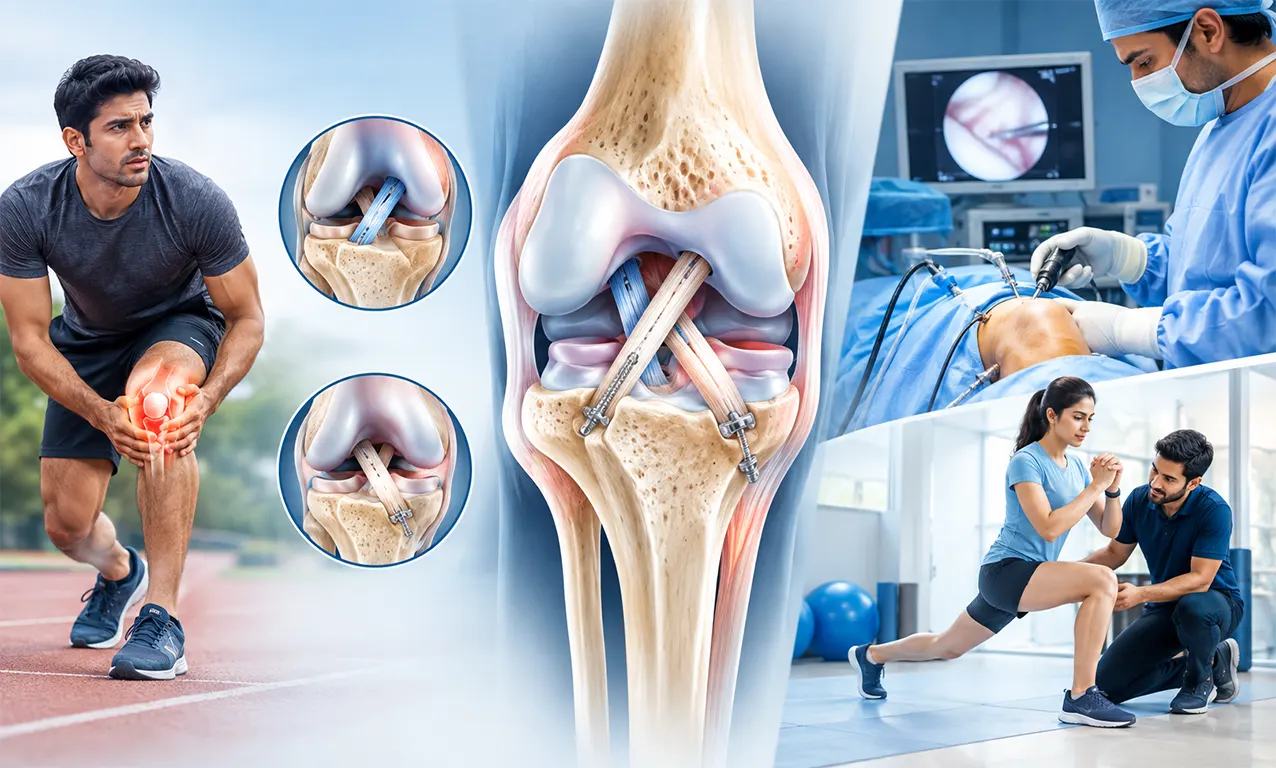
ACL & PCL Reconstruction
Restoring Knee Stability, Movement and Function
The knee is a complex joint that depends on strong ligaments to maintain stability during walking, running, jumping and changes in direction. The anterior cruciate ligament (ACL) and posterior cruciate ligament (PCL) are two important ligaments located inside the knee that help control the movement of the thighbone and shinbone.
Injuries to these ligaments are common in sports and high-impact accidents. A significant tear can cause pain, swelling, instability and difficulty returning to normal activities. Depending on the severity of the injury, activity level and associated damage, treatment may involve structured rehabilitation or surgical reconstruction.
ACL and PCL reconstruction uses a tissue graft to replace the damaged ligament and restore stability to the knee. The appropriate treatment is determined after a detailed clinical assessment and imaging.
What Are the ACL and PCL?
The ACL (Anterior Cruciate Ligament) helps prevent excessive forward movement of the tibia and contributes to rotational stability of the knee.
The PCL (Posterior Cruciate Ligament) helps prevent excessive backward movement of the tibia and works with the ACL to maintain stability during movement.
Because these ligaments play an important role in knee stability, significant injuries can affect everyday activities as well as sports performance.
How Do ACL and PCL Injuries Occur?
ACL injuries frequently occur during sports or activities involving sudden stopping, pivoting, landing or changing direction. They can also result from direct trauma or accidents.
PCL injuries are often associated with a strong impact to the front of the shin, such as during a road traffic accident or sports collision. More severe injuries can involve multiple knee ligaments or damage to the meniscus and cartilage.
Common Symptoms
Symptoms can vary depending on the ligament involved and the extent of the injury. Common symptoms include:
- Pain around the knee
- Swelling, particularly after an acute injury
- Difficulty putting weight on the affected leg
- Reduced knee movement
- A feeling that the knee is unstable or may give way
- Difficulty running, jumping or changing direction
- Reduced confidence while participating in sports
- Persistent instability following an injury
A knee that repeatedly gives way should not be ignored, as ongoing instability may contribute to additional damage within the joint.
How Are ACL and PCL Injuries Diagnosed?
Diagnosis begins with a detailed medical history and physical examination. The mechanism of injury, symptoms, knee stability and activity requirements are important factors in determining the extent of the injury.
Imaging may also be recommended. MRI scans can help identify ligament tears and associated injuries involving the meniscus, cartilage or other knee structures. X-rays may be used when a fracture or other bone injury is suspected.
Does Every ACL or PCL Tear Need Surgery?
Not every ligament injury requires reconstruction.
Treatment depends on several factors, including:
- Whether the tear is partial or complete
- The degree of knee instability
- The patient's age and activity level
- Sporting and occupational requirements
- Associated meniscus, cartilage or ligament injuries
- Response to physiotherapy and rehabilitation
- The patient's individual goals
Some patients with less severe injuries may achieve satisfactory function with appropriate non-operative treatment and rehabilitation. However, surgical reconstruction may be considered when significant instability persists, particularly in active individuals or when the injury occurs alongside other structural damage.
For ACL injuries requiring surgery, current orthopaedic guidance generally favours reconstruction rather than traditional repair in appropriate cases.
What Is ACL Reconstruction?
ACL reconstruction is a surgical procedure in which the damaged ACL is replaced with a new ligament created from a tendon graft.
The graft may be obtained from the patient's own body (autograft) or, in selected circumstances, from donor tissue (allograft). Common autograft options include the patellar tendon, hamstring tendon and quadriceps tendon.
The choice of graft depends on several factors, including age, activity level, sporting requirements, previous surgery and individual circumstances.
ACL reconstruction is commonly performed using arthroscopic techniques, allowing the surgeon to work through small incisions with a camera and specialised instruments.
If a meniscus tear or other treatable injury is present, it may be addressed during the same surgical procedure when appropriate.
What Is PCL Reconstruction?
PCL reconstruction is performed to restore stability when a PCL injury is significant and does not adequately respond to non-operative treatment, or when it occurs as part of a more complex knee injury.
During reconstruction, the damaged ligament is replaced with a tendon graft. The graft is positioned and secured to reproduce the function of the original PCL.
Surgery may be particularly important when PCL injury is associated with multiple ligament injuries or when persistent instability and pain affect knee function.
What Happens After Reconstruction?
Successful recovery after ACL or PCL reconstruction involves much more than the surgical procedure itself.
A structured rehabilitation programme is an essential part of recovery. Depending on the procedure and individual circumstances, rehabilitation may focus on:
- Controlling pain and swelling
- Restoring knee movement
- Regaining muscle strength
- Improving balance and coordination
- Gradually restoring normal walking
- Developing functional strength
- Sport-specific rehabilitation when appropriate
- Gradually returning to physical activities
Physical therapy generally begins early after surgery and progresses according to factors such as pain, range of motion, muscle strength and healing.
The timeline for returning to work, exercise or competitive sport varies from person to person. Returning to demanding activities too early can increase the risk of complications or reinjury, so rehabilitation should be progressed according to the treating surgeon and physiotherapy team.
Why Is Rehabilitation So Important?
Reconstruction restores the damaged ligament, but the knee still needs time and appropriate rehabilitation to regain strength, movement and functional control.
A carefully planned rehabilitation programme helps patients progressively rebuild the muscles around the knee and improve balance, coordination and confidence. For athletes, rehabilitation can also include sport-specific movement and gradual return-to-play preparation.
The goal is not simply to complete surgery—it is to restore a stable, functional knee and help the patient safely return to the activities that matter to them.
ACL & PCL Reconstruction at Dr. Ashwin Roby
Dr. Ashwin Roby provides arthroscopic and sports surgery, including ACL and PCL reconstruction, as part of his knee and sports injury services. His approach focuses on accurate diagnosis, appropriate surgical decision-making, preservation of healthy tissues where possible and structured rehabilitation.
Every knee injury is different. The decision to undergo reconstruction should be based on the type and severity of the injury, knee stability, associated damage, activity requirements and individual treatment goals.
If you have suffered a knee injury or are experiencing persistent instability, a specialist orthopaedic assessment can help determine the appropriate treatment pathway.
When Should You Seek Medical Assessment?
You should consider an orthopaedic evaluation if you experience:
- Repeated episodes of the knee giving way
- Persistent swelling after a knee injury
- Difficulty walking or bearing weight
- Ongoing pain or restricted movement
- Instability while running or changing direction
- Difficulty returning to sports after an injury
- A known ACL or PCL tear
Early assessment can help identify the extent of the injury and any associated damage, allowing an appropriate treatment and rehabilitation plan to be developed.
Restore Stability. Rebuild Strength. Return to Movement.
ACL and PCL injuries can significantly affect knee function, but appropriate diagnosis, treatment and rehabilitation can help restore stability and improve function.
Dr. Ashwin Roby
Orthopaedic Surgeon
MBBS, MS (Ortho), DNB (Ortho)
Fellowship in Arthroscopy & Arthroplasty, Adelaide, Australia
Clinical Locations:
Dr K Damodaran Memorial Hospital, Chinnakada, Kollam
Azeezia Medical College, Meeyanoor, Kollam